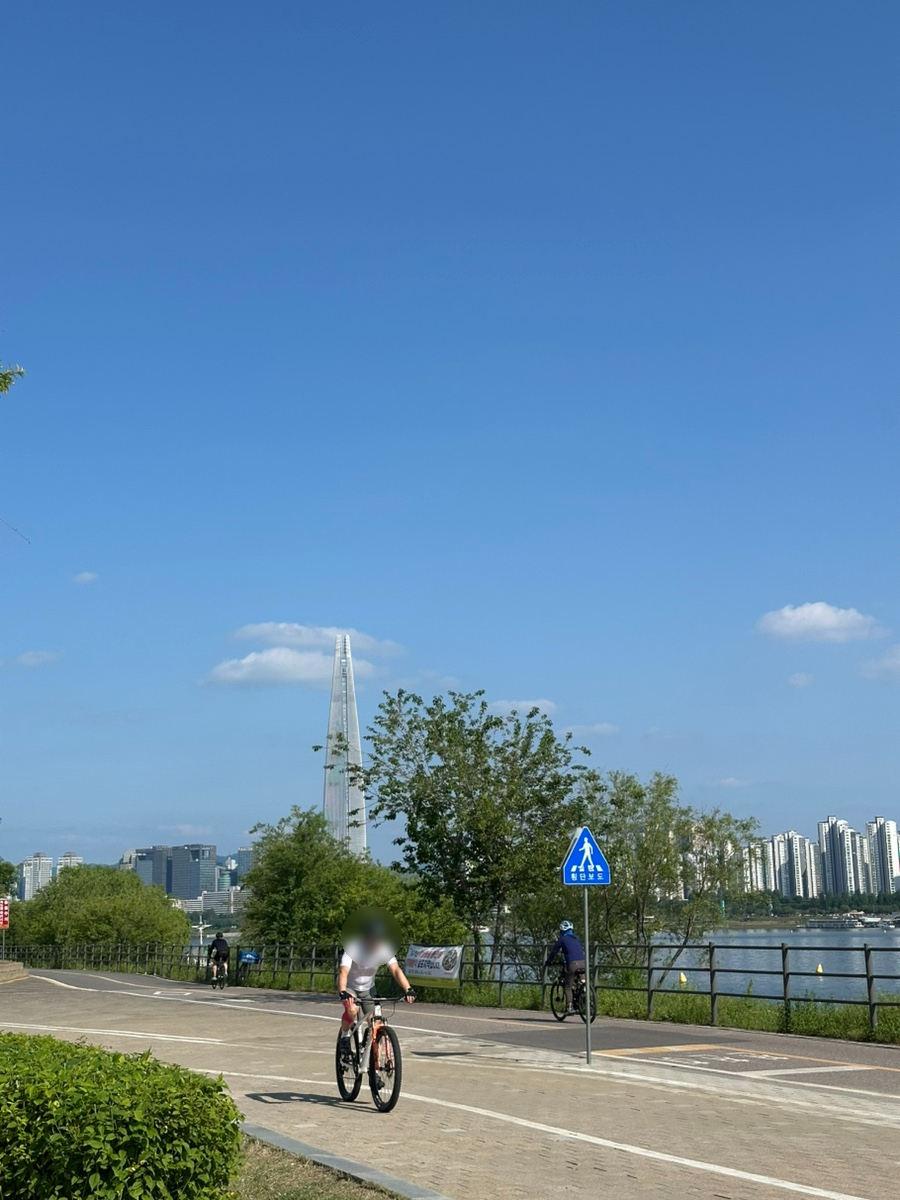
Riding a bike along the Han River is one of those Seoul experiences that looks effortless in every travel video — until you try to rent the bike. Most guides point you to Ttareungi, the city’s public bike system, which is great for Koreans and genuinely annoying for visitors (app registration, payment quirks, the works). Here’s the local shortcut: at Ttukseom, Han River bike rental works the old-fashioned way — walk up, pay at a kiosk with any card, ride off. This is exactly how I do it.

Where to rent
Take Line 7 to Jayang Station and use Exit 2 — the rental shop is literally at the bottom of the stairs (Google Maps). There’s another one right by Exit 1; both are equally close, so pick whichever has the shorter line.
For context: Seoul runs official bike rental shops at 12 Han River park locations, and Ttukseom’s is one of the biggest, with about 210 bikes — so even on busy days, stock rarely runs out.
Official hours (per the Seoul Hangang Park office, and matching what I saw posted on my April visit):
- March–October: 10am–8pm daily
- November–February: 11am–7pm — Ttukseom is one of the few large shops that stays open through winter; most smaller riverside shops close for the season
- Hours can shift with weather, so glance at the notice by the kiosk when you arrive.

Bikes and prices (official rates, 2026)
The fleet covers pretty much every group configuration. Rentals run on a 1-hour base with 1.5- and 2-hour options:
| Bike type | 1 hour | 1.5 hours | 2 hours |
|---|---|---|---|
| Single / kids’ bike | 3,300 KRW | 4,950 | 6,600 |
| Tandem (two-seater) | 6,600 | 9,900 | 13,200 |
| Bike with child seat | 5,000 | 7,500 | 10,000 |
| Electric bike | 9,000 | 13,500 | 18,000 |
| Four-wheel family quad (3–4 people) | 20,000 | 30,000 | 40,000 |
| Premium bike | 7,000 | 10,500 | 14,000 |
(For reference, 3,300 KRW is about $2.50.)

Ordering is via kiosk, with English supported: pick your bike type and hours, enter a phone number (it’s used to identify your rental), and pay by card. No app, no membership.
One rule worth knowing before you plan a one-way adventure: you return the bike to the same shop you rented from. Cross-returns at other Han River shops are technically possible only on weekdays, with advance booking, and only for premium MTBs or groups of five-plus — in other words, not a tourist scenario. For one-way trips, that’s what Ttareungi (below) is for.

The two-slip system (and the late fee)
The kiosk prints two identical receipt-style slips (이용권): show one to the staff to get your bike, and keep the other — you must hand it back when you return the bike. Zip it into a pocket or bag before you ride off. Nobody explains this in English at the counter, so consider yourself briefed.
Each slip prints your rental time and return deadline, and three official rules apply:
- Return late, pay extra. Overtime is charged as an additional fee at return — the slip itself warns you. Note your deadline before setting off and build in a buffer for the ride back (the riverside path has a way of making you forget the time).
- Lost your slip? Return the bike anyway and tell the staff so they can process the return manually.
- Never just walk away from an unprocessed return — per the official rules, a rental that’s never checked back in is treated as bike theft. Thirty seconds at the counter saves you a very bad day.

A local’s bike-picking checklist
To be fair: most of the bikes are in perfectly good shape. But rental fleets live hard lives, and a one-minute check filters out the occasional dud:
- Sit on the bike before committing. Your feet shouldn’t dangle, your knees shouldn’t fold — and if the saddle needs adjusting, some models are tricky to adjust yourself; just ask the staff, who’ll sort it in seconds.
- Test the brakes with a quick roll.
- Check that the handlebars and front wheel actually point the same way. The occasional well-loved bike has drifted out of alignment, and riding one feels like steering a shopping cart. Swap it.
What about Ttareungi (the public bikes)?
The green public bikes have docks at Jayang Exits 1, 2, and 3, and they have one real advantage: you can return them at any dock in the city, which makes one-way trips possible — ride to Jamsil and subway back, say. If you’re up for the app registration (foreign cards can be finicky), it’s the cheaper option. For a simple ride-and-return afternoon, though, the walk-up shops win on zero hassle.
The ride itself
From Ttukseom, the riverside path between Seongsu Bridge and Jamsil Bridge is an easy, flat, scenic stretch — water on one side, the city gliding by on the other. Build in a stop at a riverside convenience store for the classic instant ramyeon break (the machines do the cooking; the view does the rest). We rode slow, ate noodles, took too many photos, and called it a full day.
Rules of the path (the official ones, briefly): stick to the marked bike lanes, keep right and ride single file, stay under 20 km/h inside the park, no phones or earphones while riding, lights on after dark, and kids ride with an adult. The paths are shared with serious lycra-clad cyclists who move fast — keeping right isn’t just polite, it’s self-preservation.

Local tips
- This pairs perfectly with everything else at Ttukseom — see my Han River picnic guide for the tent-and-chicken half of the day. Bike in the afternoon, picnic at sunset is the ideal order. And when you’re hungry after riding, there’s excellent cold buckwheat noodle right by the park — see my Ttukseom makguksu guide.
- Weekend afternoons get busy on the path; mornings are emptier and cooler.
- The tandem bike is the couples’ classic, but fair warning: it’s harder to balance than it looks. Great for laughs, slower for distance.
Verdict
Ttukseom is the easiest Han River bike rental spot in Seoul: subway exit, kiosk, card, ride — no app gymnastics. Check your saddle, guard that second ticket, point yourself between the bridges, and you’ve got one of the city’s best afternoons for about the price of a coffee.
