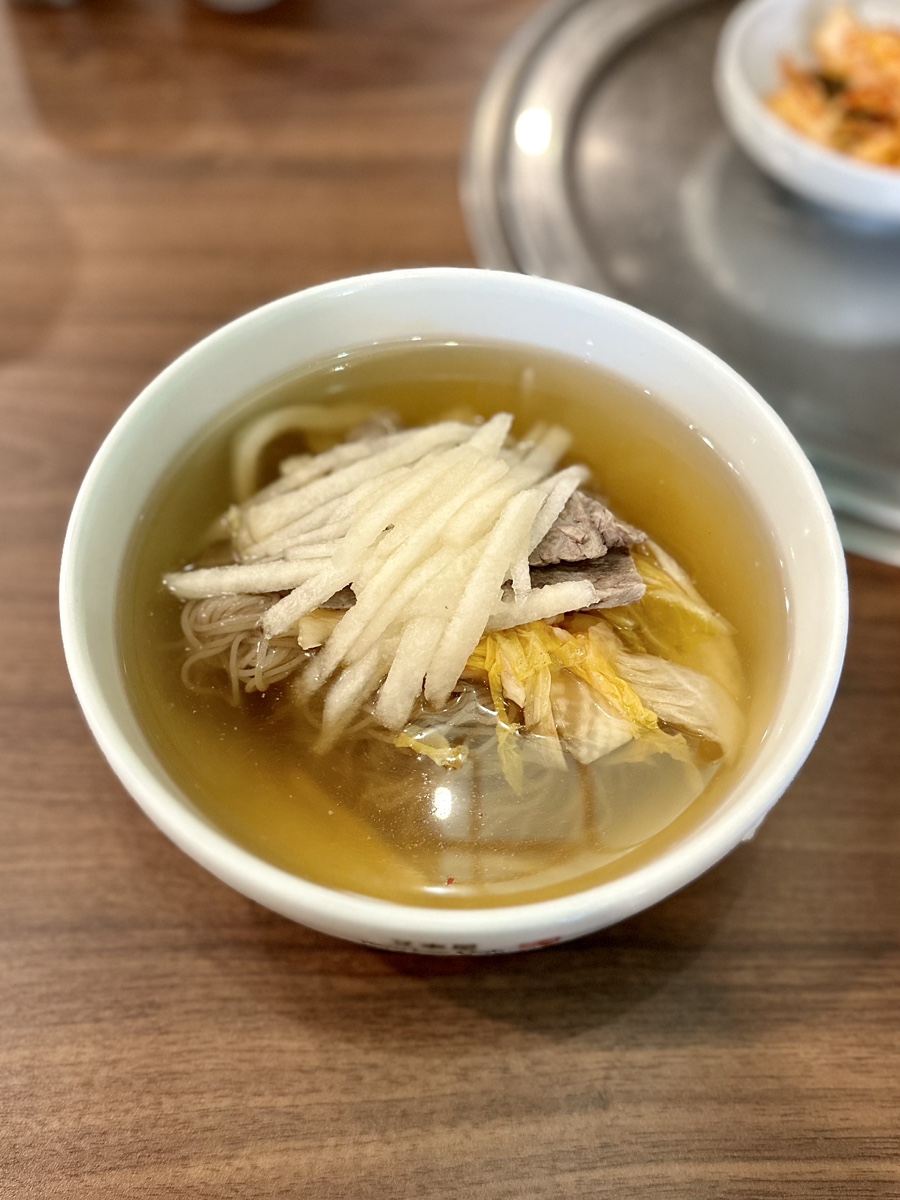
Ask Koreans about pyongyang naengmyeon and you’ll get strong opinions. It’s the cold noodle dish people either revere or find baffling — famously seum-seum, meaning so subtle it can taste like nothing at first. Woolaeok, in Euljiro, has been making it since 1946, holds a Michelin Bib Gourmand every year from 2022 to 2026, and is the place I’d send anyone trying it for the first time.

Pyongyang vs Hamhung: know the difference
Korea’s two great cold noodle traditions are nothing alike:
- Pyongyang-style — thick buckwheat noodles in a clear, chilled beef broth. Restrained, clean, and all about the broth. This is the connoisseur’s bowl.
- Hamhung-style — thin, springy noodles usually tossed in a sweet-spicy sauce. Bolder and more immediately crowd-pleasing. (I’ve written up a good Hamhung spot in Jamsil.)
If you’ve only had the spicy mixed kind, this is a completely different experience.
Why Woolaeok is the one to start with
Here’s the honest reason I recommend it over other famous names: Woolaeok’s broth is more seasoned than most.
I went expecting the legendary blandness, and it wasn’t like that at all — the broth is clean but has real depth and savor. The noodles hold together instead of breaking apart, the portion is generous, and the toppings are piled high: beef, pear, and white kimchi (baek-kimchi, a mild non-spicy kimchi).
Eating the noodles together with that tangy white kimchi is where it clicks. That’s the moment you understand what people see in this dish.
If you’ve tried pyongyang naengmyeon before and found it too plain, Woolaeok is worth another go. And if you’ve never tried it, this is the gentlest possible introduction.

The menu
All the cold noodle dishes are 18,000 KRW — the classic Pyongyang naengmyeon, the mixed bibim version, the hot onmyeon, and kimchi-mari naengmyeon (served in kimchi broth). There’s also bulgogi, yukhoe (beef tartare), and galbi, plus a solid drinks list.
The menu has English labels and photos, so ordering is straightforward. Cards accepted.
On the table: vinegar and mustard, which you can add to taste — start small. Kimchi comes on request, so just ask if you’d like some.


The waiting (plan for this)
Woolaeok is genuinely famous — it’s appeared on Korean food TV, holds its Michelin listing year after year, and made headlines when Nvidia’s Jensen Huang stopped by. That popularity shows up as a queue.
Waiting runs through the Tabling system, and the kiosk outside supports English, Japanese, and Chinese. One important limitation: you can only register in person at the kiosk — no remote sign-up, so you have to be there.
How bad can it get? On a Sunday at 1pm I was number 150 in line — about a 90-minute wait. Weekdays can have no queue at all.
So: come on a weekday if you possibly can. If you do land in a weekend queue, Tabling notifies you by KakaoTalk or text message when your turn approaches, so you can wait at a nearby cafe rather than standing outside. There’s also an indoor waiting area on the first floor, though it fills up when the line is long.


The dining room itself is large, spread over two floors, so tables turn over faster than the queue length suggests.

Details
- Location: 62-29 Changgyeonggung-ro, Jung-gu — 1 minute from Euljiro 4-ga Station Exit 4 (Google Maps)
- Hours: 11:30am–9:00pm (last order 8:20pm), closed Mondays
- Price: cold noodle dishes 18,000 KRW
- Valet parking available for 3,000 KRW, but the station exit is right there — come by subway.
Verdict
Pyongyang naengmyeon divides people, and Woolaeok is the best argument for the believers: a 1946 institution with a broth that’s clean but never empty, noodles with proper bite, and white kimchi that ties it together. Come on a weekday, register at the kiosk, and give it your full attention — it’s one of the most quietly impressive bowls in a Seoul summer.
