Most people come to Daejeon for one thing: Sungsimdang, the bakery worth a day trip from Seoul. But you can’t live on bread alone, and Daejeon is a city that takes eating seriously. So here’s what to eat in Daejeon once you’ve got your bag of pastries — a bowl of the city’s fiery signature dish, at a place locals have loved since 1972.
(First time making the trip? Our guide on how to get to Daejeon from Seoul covers the KTX, SRT, bus and budget-train options.)

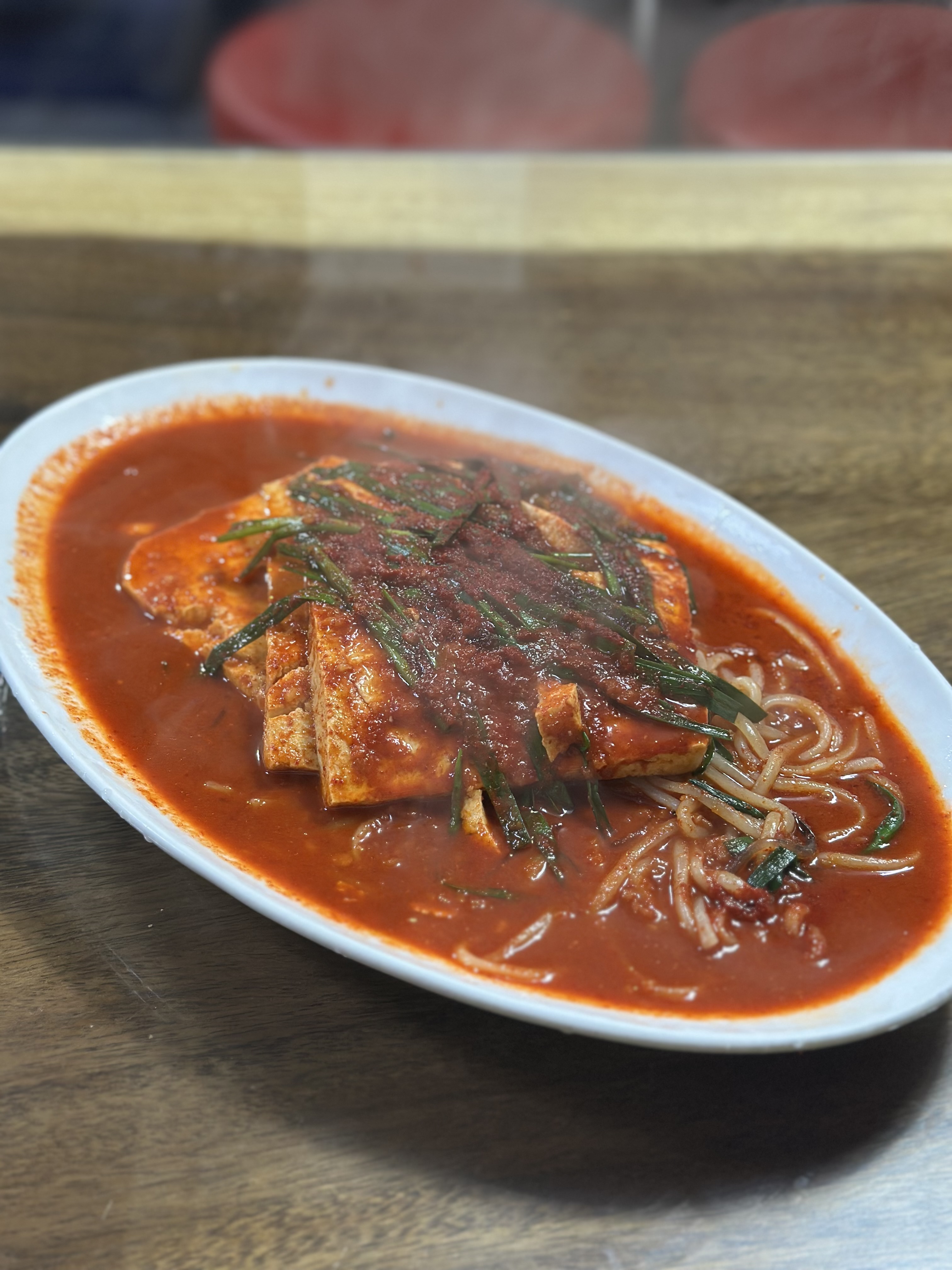
Meet dubu-duruchigi (Daejeon’s signature dish)
Dubu-duruchigi is Daejeon’s local specialty: slices of soft tofu braised in a shallow, spicy-savory red chili sauce, usually eaten with noodles mixed in, rice on the side, or both. It’s homey, punchy comfort food you’ll rarely see done this way outside the city — which is exactly why it’s worth ordering here.
Byeolnanjip (“the peculiar house”) has been making it since 1972. Along with a nearby spot called Jinrojip, it’s considered one of the two great names for dubu-duruchigi in Daejeon — a proper local institution, its walls papered with Blue Ribbon Survey awards going back years.

⚠️ A serious spice warning
Let’s be direct: this is spicy even by Korean standards. If you’re not used to Korean chili, the dubu-duruchigi alone will be a challenge.
Here’s the local move to handle it — and the way I actually ate it: order the nokdu-jijim (mung bean pancake) alongside. The mild, savory, crispy pancake balances out the heat beautifully, so you get relief between fiery bites. If you’re really not a spice person, add a bowl of rice too; mixing the sauce into rice tames it further.


What to order
The menu is short, and there are only two mains:
- Dubu-duruchigi — 16,000 KRW (the spicy braised tofu; comes with a little noodle already in it)
- Nokdu-jijim — 15,000 KRW (mung bean pancake; contains pork, and can’t be made without it)
The restaurant helpfully posts recommended combinations by group size — here’s how to order:
- For 2: dubu-duruchigi + extra noodles, or dubu-duruchigi + nokdu-jijim
- For 3–4: dubu-duruchigi + nokdu-jijim + extra noodles
- For 5–6: two dubu-duruchigi + two nokdu-jijim + two extra noodles
My recommendation: the dubu-duruchigi + nokdu-jijim combo, for the spice-balancing reason above.
A few ordering notes worth knowing:
- Extra noodles (2,000 KRW) can only be added with your first order, since they’re cooked into the dish — decide up front.
- There’s also a perilla-oil mixed noodle add-on (3,000 KRW) you can order partway through.
- Rice is ordered separately (1,000 KRW) — it doesn’t come automatically, so ask for it.

How to eat it
Once it arrives, the ritual is simple and satisfying:
- Twirl up the noodles sitting in the sauce — they soak up all that spicy flavor.
- Mix rice into the leftover sauce at the end, the way locals finish it off.
- Alternate with the nokdu-jijim to give your mouth a break.


The place itself
Byeolnanjip is a proper old-school spot — a busy, worn-in basement room full of locals, exactly the kind of place you hope to stumble into.

It gets crowded, and there’s a catch worth knowing: you cannot wait inside. You add yourself to the list at the entrance — writing the last four digits of your phone number and your party size — and wait outside; there’s a posted notice apologizing for it. Come slightly off-peak if you can.


Details
- Location: Byeolnanjip, Jung-gu, Daejeon — about an 11-minute walk (650m) from Daejeon Station (Google Maps)
- Hours: 11:00am–10:00pm daily, no closing day
- Prices: dubu-duruchigi 16,000 / nokdu-jijim 15,000 KRW
- Ordering: no English menu — check the restaurant’s Naver Map listing for photos beforehand, or point at the pictures. Staff order at the table.
- Waiting: add your phone number’s last 4 digits and party size to the list at the door, then wait outside; no inside waiting.
Verdict
Once you’ve done the Sungsimdang bread run, this is what to eat in Daejeon to round out the trip: a plate of fiery, tofu-and-noodle comfort food at a 50-year-old local institution. Brace for the heat, order the mung bean pancake to balance it, mix rice into the sauce at the end — and you’ll understand why Daejeon calls itself a city of food, not just bread.
