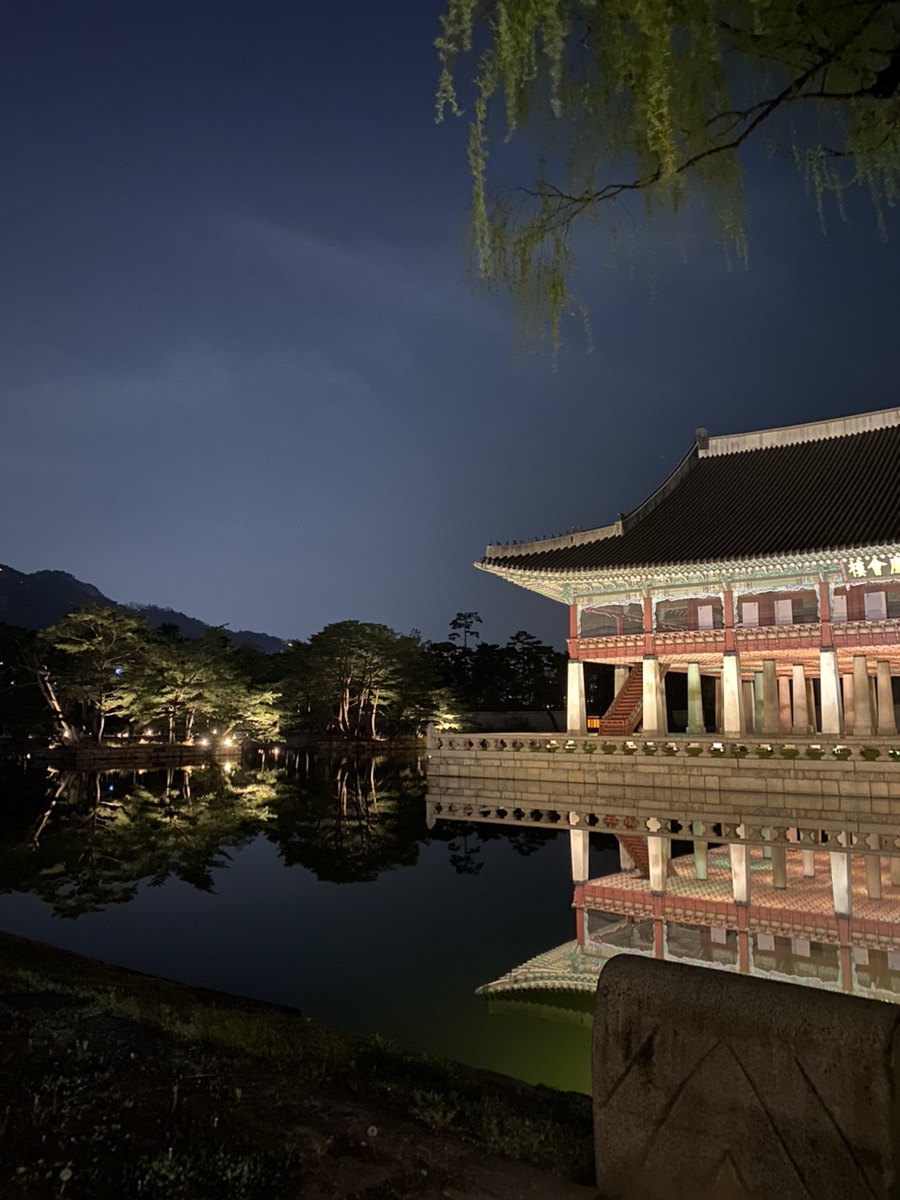
Twice a year, for roughly a month each time, Gyeongbokgung Palace stays open after dark — lanterns on, halls glowing, the works. It’s one of the most beautiful things you can do in Seoul, and also one of the most confusing to book if you’re not Korean. I’ve been, and here’s the honest system, including the two routes that actually work for foreign visitors.

When it happens
The Gyeongbokgung night opening runs in two sessions a year — one in spring and one in fall — each lasting about a month. For reference, the 2026 spring session ran May 13 to June 14, with viewing from 7pm to 9:30pm (last entry 8:30pm) and the palace dark on Mondays and Tuesdays. Expect future sessions to follow a similar pattern.
Exact dates are announced on the official Royal Palaces site (royal.khs.go.kr) shortly before each session — or check back here, as I update this post each season.
The ticket system, translated honestly
Tickets are 3,000 KRW (about $2), with 3,300 visitors admitted per night. Here’s how the spots break down — and what each route means for you:
| Route | Who it works for | The reality |
|---|---|---|
| Online pre-booking (3,000/night) | Koreans | Sold via Interpark NOL with Korean verification — effectively impossible for short-term visitors. Sells out within days of opening |
| Same-day on-site tickets (300/night) | Foreigners only | 3,000 KRW, max 2 per person, passport required. First come, first served |
| Free entry (no limit) | Hanbok wearers, kids under 6, seniors 65+ | No ticket, no reservation — show your passport at Heungnyemun Gate and walk in |
Most English articles skip the first row’s fine print and cheerfully send you to a booking page that will reject you. Don’t waste an evening on it — you have two real options, and the second one is better.
Option 1: The 300 same-day foreigner tickets
Every opening night, 300 tickets are reserved exclusively for foreign visitors and sold on site. Bring your passport (required as proof of eligibility), and note the 2-tickets-per-person cap — a family of four needs two adults in the line. On the weekday evening I went, the palace never felt overcrowded, but 300 is still a hard number: arrive early rather than strolling up at 8pm.
Bonus tip if you have a Korean connection: online tickets can be cancelled free until 5pm the day before, so cancellations pop up right around that deadline. If a Korean friend or long-term resident is booking for your group, that’s the window to watch on Interpark NOL.
Option 2 (my recommendation): Wear a hanbok, walk in free
Anyone wearing a hanbok enters free, with no ticket and no headcount limit — you skip the entire ticket question. And here’s the detail that makes it genuinely practical: during the night opening season, most hanbok rental shops around the palace extend their hours to about 9:30pm, so evening rental is no problem.
The math is hard to argue with: for the price of a rental you get guaranteed entry on any opening night, plus the photos of your life — a hanbok inside a lantern-lit palace is the single most photogenic thing you can do in Seoul.
One rule that matters: the palace enforces a proper-hanbok guideline (a real hanbok worn correctly — top and bottom, not a costume-ish variation), and staff check at the gate. Rental shops near the palace know the rules; when in doubt, tell them it’s for palace entry. The official guideline is linked on the Royal Palaces site.

Getting there
- Address: 161 Sajik-ro, Jongno-gu, Seoul (Google Maps)
- Subway: Gyeongbokgung Station (Line 3), Exit 5 — about a 10-minute walk
- Skip driving: there is a parking lot, but it fills fast during the night season. The subway is painless.
What it’s actually like inside
I went on a weekday evening — pleasantly cool air, barely any wind — and spent about 1 to 1.5 hours on a full loop. It never felt uncomfortably packed.

From Heungnyemun Gate I walked toward Geunjeongjeon, the throne hall, where the lighting catches the old stone courtyard so it glitters underfoot. By day this is just a wide plaza; at night, the lit columns and the sharp shadows of the eaves turn the architecture almost theatrical.


The hands-down highlight is Gyeonghoeru Pavilion. On a still night the pavilion mirrors perfectly on its pond — it’s the image everyone associates with the night opening, and it’s worth waiting your turn at the railing for the shot.
Finish with the royal living quarters — Gangnyeongjeon, Gyotaejeon, and the Amisan garden with its famous chimneys. Far fewer people make it back here, so the last stretch feels like a quiet evening stroll through a 600-year-old backyard.

Curious what each of these halls actually was — who lived there, where Hangul was invented, why the pavilion sits on a pond? I’ve explained the palace hall by hall in my Gyeongbokgung Palace guide.
Two practical notes: parts of the grounds are genuinely dark, so wear comfortable shoes, and bring a light layer — palace evenings run cooler than the streets outside.
Local tips
- Last entry is 8:30pm, but don’t cut it close — give yourself the full 90 minutes.
- The palace rests on Mondays and Tuesdays during the night season; plan around it.
- Free-entry visitors (hanbok, under 6, 65+) go straight to Heungnyemun Gate with passport/ID — no ticket line at all. Kids under 6 are free but their guardians still need tickets (or hanbok).
- Make it a full Jongno evening: the palace pairs perfectly with dinner nearby — my Songam Onban hanok restaurant in Ikseon-dong, or an early stop at Cafe Onion Anguk, are both a short walk or one subway stop away.
- If your travel dates overlap a session, treat it as a plan-the-evening-around-it event. Miss it, and the next chance is roughly half a year away.
Verdict
The Gyeongbokgung night opening is Seoul’s best month of the year, hidden behind a booking system that quietly excludes the people most excited to see it. Now you know the workaround: 300 passport-in-hand tickets a night, or the hanbok that gets you in free — dressed for the occasion, no alarm-clock ticketing required. I know which one I’d choose.
