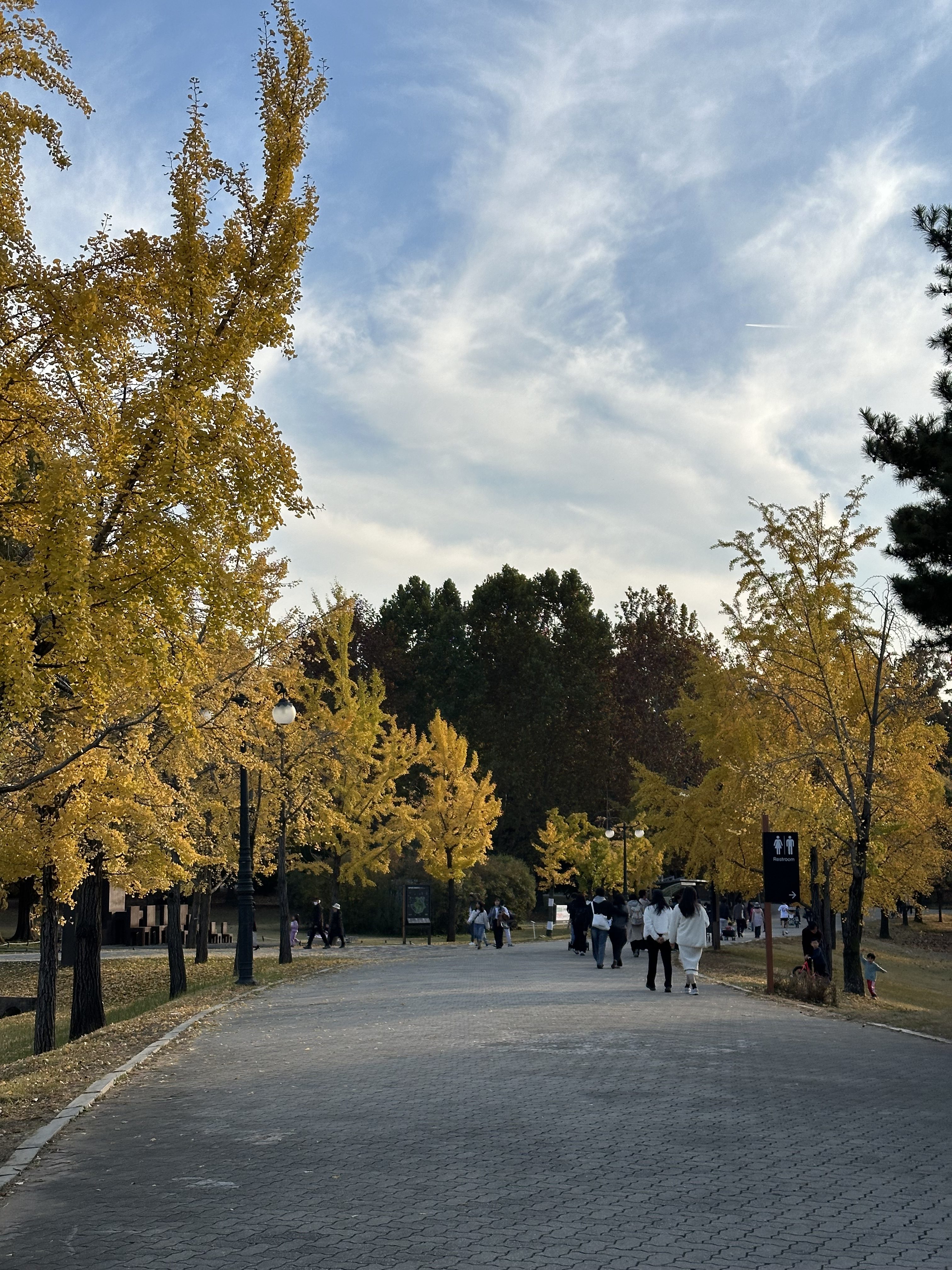
Olympic Park in autumn in Seoul is one of the city’s best-kept fall foliage secrets. The 1988 Seoul Olympics site has since grown into a sprawling green space anchored by golden ginkgo paths, 2,000-year-old earthen fortress walls, over 200 outdoor sculptures, and rolling open lawns you can actually stretch out on. When the leaves turn, it becomes one of the few places in Seoul where you can genuinely feel the season without leaving the subway network. Here’s my local guide.

Where Is Olympic Park
Olympic Park (올림픽공원) sits in Songpa-gu, in Seoul’s southeast — the same district as Jamsil and Seokchon Lake, just two subway stops east. At 1.45 km², it’s one of Seoul’s largest green spaces (roughly 2.5 times the size of Yeouido Park), which means it never feels crowded even at peak foliage weekends (Google Maps · Naver Map).
Getting there:
- Olympic Park Station (Lines 5 and 9) — Exit 3 puts you at the iconic World Peace Gate, the main ceremonial entrance
- Mongchontoseong Station (Line 8) — Exit 1 is the closer entry for the ginkgo paths, Mongchontoseong fortress, and the Lone Tree
If you’re planning a bigger day in the area, Olympic Park is part of my full guide to things to do in Jamsil — pair it with Seokchon Lake or Lotte World for a complete day out.
When to Go: 2026 Peak Foliage
Peak foliage for Olympic Park in autumn in Seoul in 2026 is expected to fall between late October and mid-November, with the ginkgo trees typically hitting their gold peak around November 5–15. The park’s mix of ginkgo, maple, and metasequoia means the color show actually stretches over a solid three weeks — ginkgoes go golden first, then maples turn red and orange right behind them.
Weather can shift the exact dates by 3–10 days in either direction, so check current forecasts a few days before your visit.
For a wider picture of when and where to catch fall colors across the city, see my full guide to autumn in Seoul.
The Ginkgo Paths: Olympic Park’s Fall Showstopper
If Olympic Park has a headline act in autumn, it’s the ginkgo-lined walking paths near the northern entrance. In peak season the whole avenue glows gold — trees on both sides, fallen leaves carpeting the brick path underfoot, and a wide-open sky overhead that keeps it from feeling closed in.

Golden hour (roughly 15:30–17:00 in early November) is the sweet spot — the low sun lights up the leaves from behind and turns the whole path into something photographers set alarms for. Weekday afternoons are noticeably calmer than weekends.
Mongchontoseong & The Lone Tree
Here’s what most visitors don’t know: Olympic Park is built around Mongchontoseong (몽촌토성), the earthen fortress walls of the ancient Baekje Dynasty capital, dating back to the 3rd–4th century. The gently rolling hills you’ll walk across aren’t landscaping — they’re 2,000-year-old defensive earthworks that have been part of Seoul longer than almost anything else you can visit.

In autumn, the wide open lawns around Mongchontoseong turn the whole place into a natural amphitheater — golden grass, distant tree lines just starting to turn, and a horizon that opens up in a way you almost never get in central Seoul. It’s the spot to bring a picnic mat, sit down, and actually slow down for an hour.
나홀로나무 (Naholo Namu, “the Lone Tree”) — On one of the Mongchontoseong hillsides stands a single tree that has become one of the most photographed spots in all of Seoul, especially in autumn. Locals plan entire visits around getting the shot. From Mongchontoseong Station (Line 8) Exit 1, follow the walking paths up into the fortress area — you’ll usually spot a small line of people waiting their turn to photograph it, which makes it easy to find without a map.
Autumn After Dark
One of the underrated joys of Olympic Park in autumn in Seoul is that it doesn’t close at sunset — the paths stay lit and walkable well into the evening. Once the sun drops, the atmosphere shifts completely: the crowds thin out, streetlamps cast pools of light through half-bare branches, and the fallen leaves crunch underfoot as you walk. It’s one of the quieter, more contemplative fall walks you can take in Seoul.

The park is well-lit along the main paths, but it’s genuinely large — stick to the routes near the Peace Plaza and ginkgo avenues after dark rather than venturing into the far corners.
Beyond the Leaves: Performances and Events
One thing that sets Olympic Park apart from other Seoul green spaces is that it doubles as an active performance venue. The park hosts a range of concerts, festivals, and cultural events year-round — from small outdoor performances on the Peace Plaza to larger events at KSPO Dome (formerly Olympic Gymnastics Arena) and the SOMA art museum. Autumn is a particularly active season for outdoor programming, so it’s worth checking what’s on before you go.
For the current schedule of events and performances at Olympic Park, check the official Olympic Park events page (available in English).
What to Bring & Practical Tips
- Wear comfortable walking shoes. This park is genuinely huge — a full loop covering the ginkgo paths, Mongchontoseong, and the Peace Plaza easily runs 4–5 km.
- Bring a picnic mat. The open lawns around Mongchontoseong are made for it, and locals absolutely take advantage in autumn.
- Bring a light jacket. October and November afternoons cool down fast once the sun starts dropping.
- Time it for golden hour. Arriving around 15:00–15:30 gives you the ginkgo paths in golden light, then the Peace Plaza and Mongchontoseong lawns as the sun sets behind the trees.
- Weekdays are much calmer. Weekends during peak foliage draw big crowds — not overwhelming for a park this size, but noticeable.
- Take the subway. Two stations serve the park directly, which is genuinely the easiest way in.
Pair It with the Rest of the Neighborhood
Since Olympic Park sits just east of Jamsil, don’t treat it as a standalone stop. My favorite way to do a full Jamsil-Songpa autumn day: start with an afternoon walk at Seokchon Lake in autumn for the Lotte World Tower reflection views and illumination festival, then subway two stops east to Olympic Park for a golden-hour ginkgo walk and evening picnic.
Wrap it up with dinner on Songnidan-gil — see my local’s guide to Songnidan-gil restaurants for six spots worth your appetite, from Korean BBQ to charcoal dakgalbi to Seoul-style burgers.
Verdict
Olympic Park in autumn in Seoul is the fall walk locals quietly protect — big enough to breathe in, historic enough to feel meaningful, and gorgeous enough that you’ll wonder why it isn’t on more travel guides. The ginkgo paths are the headline, but the 2,000-year-old fortress lawns, the Lone Tree, and the year-round performance schedule are what make it hit differently from every other park in the city. Bring a picnic mat, plan around golden hour, and give yourself a full afternoon — Olympic Park rewards slow visits.
