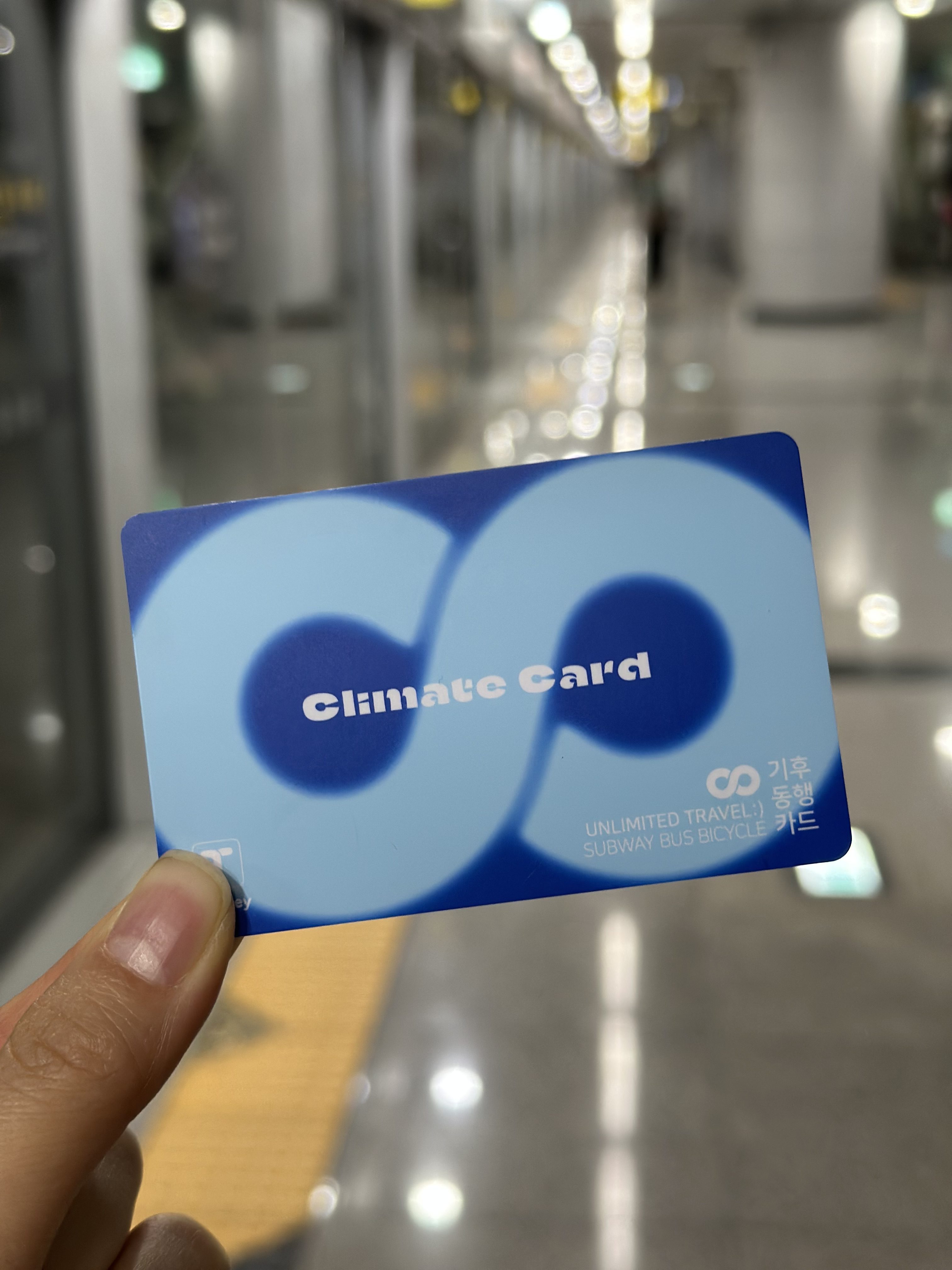
Two cards get you through Seoul’s subway and bus gates: the Climate Card (기후동행카드) and T-money. Which one you want comes down to a single question — how much will you actually ride? Here’s a local’s breakdown of the Climate Card in Seoul versus T-money for short-trip visitors.
The quick answer: staying in Seoul and riding a lot? The Climate Card Seoul short-pass saves you money. Venturing outside Seoul, or riding only occasionally? T-money is simpler. Neither choice is a mistake — Korea’s transit is cheap either way.

Quick comparison
| Climate Card (short-pass) | T-money | |
|---|---|---|
| How it works | Unlimited rides for a set number of days | Pay-as-you-go, deducted per ride |
| Price | 1-day ₩5,000 · 2-day ₩8,000 · 3-day ₩10,000 · 5-day ₩15,000 · 7-day ₩20,000 | Top up any amount (₩1,000–90,000) |
| Where it works | Seoul subway + Seoul-licensed city/village buses | Nationwide transit + convenience-store payments |
| Starts | The moment you charge it (no start-date choice) | Whenever you tap; balance just deducts |
| Foreigners | Physical card only (no mobile) | Physical card, buy & top up in cash |
The Climate Card (unlimited, Seoul-focused)
The Climate Card is Seoul’s unlimited transit pass. For visitors there’s a short-pass in 1/2/3/5/7-day versions (₩5,000 to ₩20,000) that lets you ride Seoul’s subway and city/village buses as much as you want.
Two things visitors must know:
- Foreigners can only use the physical card, not the mobile version. Buy and charge it at a subway-station kiosk, or at convenience stores near Line 9 / Ui-Sinseol / Sillim-line stations. Tourist centers in Myeongdong and the Seoul Tourism Plaza also sell the physical card — handy if you’re staying nearby.
- The pass starts the moment you charge it — you can’t pick a future start date. So charge it on the morning of the day you’ll actually use it, not the night before, or you’ll waste hours.
One more note: the short-pass covers Seoul only. It doesn’t work to Incheon Airport, on the Shinbundang line, GTX, or buses licensed outside Seoul.


Good news for 2026: you no longer need Korean cash to buy or top up. Since March 2026, new ticket machines at 273 stations on Subway Lines 1–8 accept overseas credit and debit cards (Visa, Mastercard, and more) — so you can grab a Climate Card straight off the plane without hunting for a currency exchange. Not every machine is upgraded yet, so look for the newer kiosks; if one doesn’t show the option, try another or ask at the station office. (A small overseas-card fee may apply.)

T-money (pay-as-you-go, nationwide)
T-money is the classic rechargeable card — tap on, tap off, the fare deducts. Buy it and top it up in cash at any convenience store (GS25, CU, 7-Eleven, and others) or at station kiosks. Its big advantages: it works almost everywhere in Korea, not just Seoul, and you can even use it to pay at convenience stores like a debit card.


For reference, a single Seoul ride runs about ₩1,500 by city bus and ₩1,550 by subway (adult fare). Transfers between subway and bus within 30 minutes are free.
So which should you buy?
Do the quick math on how many rides per day:
- 4–5+ rides a day, all within Seoul → Climate Card. At about ₩1,550 a ride, five rides already tops ₩7,750 — more than a 1-day pass. Heavy sightseeing days pay off fast.
- A few rides a day, or leaving Seoul (a Gyeongju day trip, Busan, or the airport) → T-money. It’s simpler, works nationwide, and Korea’s fares are low enough that pay-as-you-go rarely stings.
Honestly, even if you pick T-money and ride a lot in Seoul, you won’t overspend by much — transit here is genuinely affordable. Choose the Climate Card to optimize, T-money to simplify.
A few practical tips
- Traveling as a group? Each person needs their own card — one card can’t tap multiple people through.
- Lost card = gone. Neither card is reissuable, so keep it safe.
- Check the last train before a late night out; Seoul’s subway stops around midnight. You can look it up in Naver Map or Kakao Map, the apps you’ll be navigating with anyway.
- Tag off, every time. With the Climate Card you must tap when you exit too, on both buses and at subway gates — miss the tap-off twice and the card can be temporarily blocked for 24 hours.
Frequently asked questions
Can I use the Climate Card at Incheon Airport
No. The card doesn’t work on the AREX gates at Incheon Airport when heading into the city — pay separately with T-money or cash, then use the Climate Card once you’re in Seoul. (You may use it on covered Seoul stations for the return leg.)
Can foreigners buy the Climate Card without cash now?
Yes. Since March 2026, the newer vending machines at Lines 1–8 take overseas Visa/Mastercard credit and debit cards, so you don’t need Korean cash or a local bank account to buy or recharge a short-pass. That said, the upgrade is still rolling out — plenty of stations don’t have the newer machines yet, so it’s worth keeping a little cash as backup. If the machine in front of you doesn’t show the card option, try a larger transfer station or ask at the station office.
Is the Climate Card changing in October 2026?
Only for residents. From October 1, 2026, Seoul is keeping the short-term tourist passes (1/2/3/5/7-day) but retiring the postpaid and 30-day options. If you’re a visitor using a short-pass, nothing changes for you.
Does the Climate Card cover trips outside Seoul?
No. It’s Seoul-only. Step off at a Gyeonggi-do station (Suwon, Yongin, and the like) and you’ll pay the full separate fare for that trip. For anywhere beyond Seoul, use T-money.
Can I get a refund on the balance?
For a short-pass it’s rarely worth it — spend it down before you leave. Foreigners without a Korean bank account are directed to the T-money headquarters for any cash refund, so it’s easiest to just use up the days.
Verdict
For a Seoul-only trip packed with sightseeing, the Climate Card Seoul short-pass is the money-saver: pick the day count that matches your stay, charge it the morning you start, and ride freely. For a trip that wanders beyond Seoul or takes it slow, T-money’s tap-and-go simplicity wins. Either way, you’re set for about the price of a couple of coffees.
