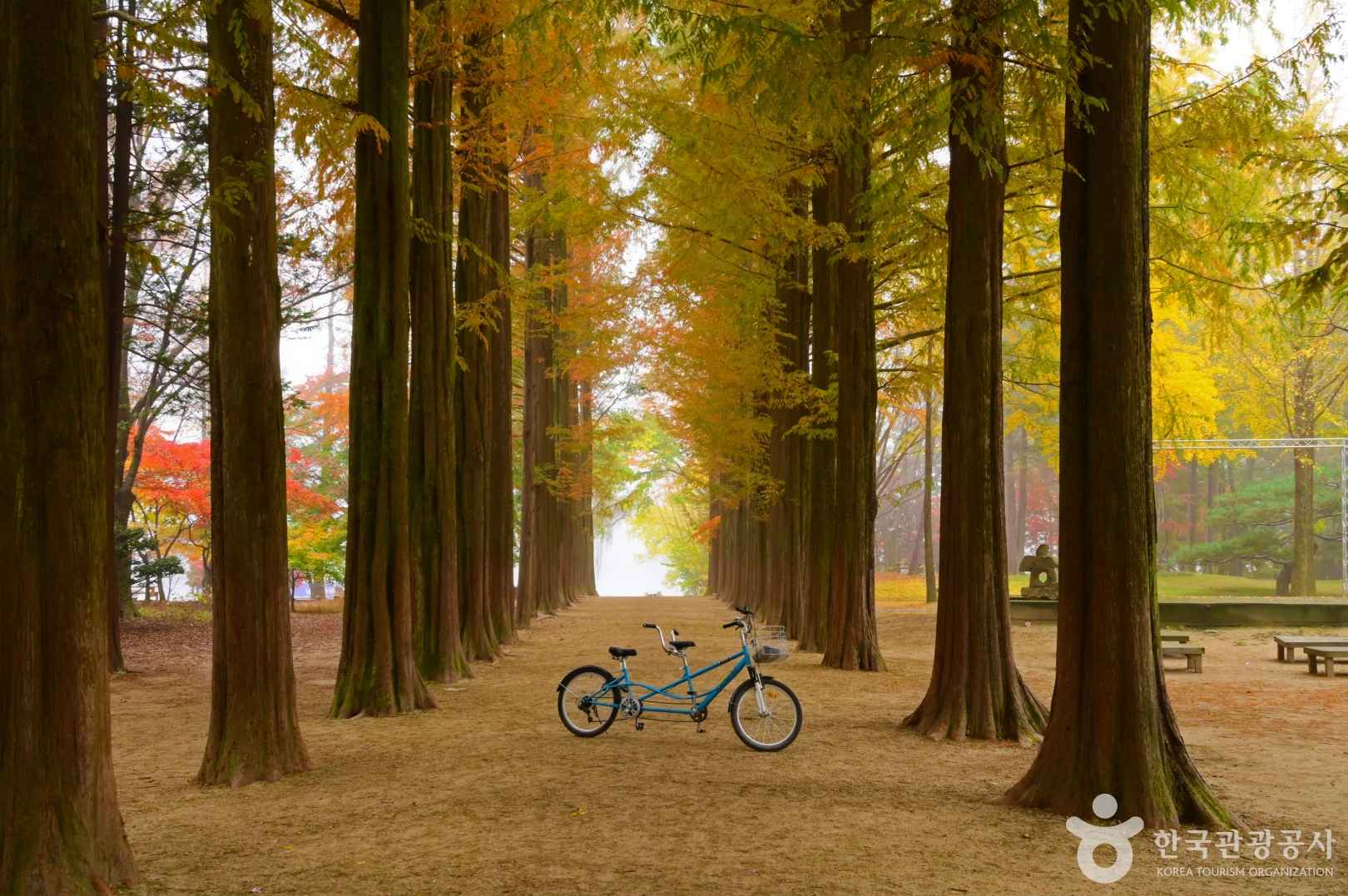
Half-moon-shaped and covered in trees, Nami Island is one of the most popular day trips from Seoul — famous as a filming location for the K-drama Winter Sonata, and beloved for its long, straight, tree-lined lanes. It’s lovely year-round, but Nami Island in autumn is when those lanes come into their own, as the metasequoia and ginkgo trees turn brilliant red and gold.
Here’s how to get there, when the color peaks, and what it costs.

What is Nami Island?
Nami (Namiseom) is a small, half-moon-shaped river island that officially belongs to Chuncheon in Gangwon Province — though in practice you reach it from Gapyeong, and that’s how everyone refers to getting there. It’s about an hour and a half northeast of Seoul, and the train route east runs from Cheongnyangni Station. It’s a private cultural resort — car-free, walkable end to end — filled with tree avenues, lawns, art installations, cafes, and animals roaming freely. The metasequoia lane is the signature shot: a tall, straight corridor of trees that’s beautiful in every season and spectacular in fall.
It’s at its best as one piece of a bigger autumn trip: pair it with our guide to autumn color across Seoul, where the palace gardens and ginkgo streets peak through November.
When the leaves peak
People search for Nami Island color as early as September, but here’s the honest timing: September is still green, the turn begins in October, and the real peak lands from late October into mid-November. Based on Nami Island’s own foliage guidance:
| What | Peak | Notes |
|---|---|---|
| Overall foliage | late Oct – mid-Nov | The most vivid, all-round window |
| Ginkgo lane | late Oct – mid-Nov | The yellow ginkgo corridor at its best |
| Late foliage / fallen leaves | after mid-Nov | Carpets of leaves, mood lingers (varies by year) |
As with any Korean foliage, dates shift by a week or two each year with the weather, so check Nami Island’s official channels close to your visit. For the fullest color with slightly thinner crowds, aim for the back half of that window.

Getting there from Seoul
Total travel time is around two hours each way. Two main routes:
- ITX-Cheongchun (from Yongsan or Cheongnyangni to Gapyeong Station) — reserved seats, roughly 40–60 minutes to Gapyeong, but it sells out on weekends and holidays, so book ahead.
- Gyeongchun Line (from Sangbong, Cheongnyangni, Hoegi to Gapyeong) — cheaper, about an hour, no reservation but you may stand at busy times.
From Gapyeong Station the wharf is about 1.5km — take the local bus (10-4) or a taxi (about 5 minutes). It’s walkable in around 20 minutes, but with luggage the bus or taxi is easier.
Direct shuttle bus: if you’d rather skip the transfers, direct shuttle buses run to Nami from central Seoul pickup points like Hongdae (Hongik Univ.), Myeongdong, and Dongdaemun History & Culture Park. Check the operator’s page for exact times and book ahead on weekends.
For a full breakdown of every route — train times, fares, the shuttle schedule, and how to cover the last stretch to the wharf — see my complete guide to getting to Nami Island.

Getting onto the island: ferry or zip-wire
Nami is reached by a short ferry across the North Han River — and the admission ticket includes the round-trip boat.
Admission (includes round-trip standard ferry):
- Adult — 19,000 KRW
- Discounted (middle/high schoolers, seniors 70+, others) — 16,000 KRW
- Special / early-bird (36 months–elementary, or boarding before 08:00 / late evening) — 13,000 KRW
There’s also a pricier option that gets you to the island by motorboat on the way in (standard ferry back out): 29,000 KRW adult, 26,000 discounted, 23,000 special. The standard ferry is perfectly good for most visitors — the motorboat is just a faster, more fun crossing if you fancy it.
Ferry hours: boats run frequently — every 10–20 minutes through the day. The first boat to the island is around 08:00 (07:30 in the autumn season, roughly Sept 18–Nov 22) and the last back is 21:00, with longer hours in peak seasons. The crossing plus walk takes only about 5 minutes.
Or arrive by zip-wire: for a memorable entrance, the Nami Island Zip-wire (Family Course, 55,000 KRW) launches you from an 80m tower and glides you ~1km across the river straight onto the island — the zip-wire fee includes your admission, and you take the ferry back out. It runs 09:00–18:00, weather permitting.


What to do on the island
The joy of Nami is simple: walk the tree lanes. The metasequoia and ginkgo corridors are the headline, especially in autumn, and there are lawns, riverside paths, sculptures, cafes and craft shops scattered throughout. It’s compact enough to see in a half-day but pleasant enough to linger.


The animals are a fun bonus, especially with kids — ostriches, rabbits, ducks and peacocks roam the grounds freely, used enough to people that you can watch them up close.
Practical tips
- Go on a weekday if you can — weekends and peak foliage draw big crowds, and ITX seats sell out.
- Start early. An early boat means quieter lanes for photos before the day-trippers arrive.
- It’s walkable and car-free, so comfortable shoes help; the island is bigger than it looks.
- Open 365 days a year, so it works as a rain-or-shine plan.
- Pair it with other Gapyeong sights (rail bike, Garden of Morning Calm) if you’re making a full day or overnight of it.
Frequently asked questions
When is the best time to see autumn colors on Nami Island?
Late October to mid-November is the peak for both the metasequoia and ginkgo lanes. Early-to-mid October catches the first turn; after mid-November you get carpets of fallen leaves. Dates shift a week or two each year with the weather.
Is Nami Island worth visiting in October?
Yes — mid-to-late October is when the color really starts, and late October is close to peak. Early October is still greener, so aim for the second half of the month for the fullest foliage.
What do the metasequoia and ginkgo lanes look like in autumn?
The metasequoia corridor turns deep red-brown and the ginkgo lane goes brilliant yellow — the two signature autumn shots on the island, both at their best from late October into mid-November.
How much does Nami Island cost?
General admission is 19,000 KRW for adults and includes the round-trip standard ferry, with discounted (16,000) and special/early-bird (13,000) tiers. A motorboat-in option costs more (29,000 adult). The zip-wire entrance is 55,000 KRW and includes admission.
How do you get to Nami Island from Seoul in autumn?
The same routes as any time of year — ITX-Cheongchun train, Gyeongchun Line, or the direct shuttle — but book ahead, because autumn weekends are the busiest of the year. See my full guide to getting to Nami Island.
Verdict
Nami Island in autumn delivers exactly what the photos promise: long avenues of metasequoia and ginkgo in full red-and-gold, an easy ferry ride from a walkable, car-free island, and enough lawns, cafes and roaming animals to fill a relaxed day. Aim for late October to mid-November, take an early boat, and walk the tree lanes before the crowds. For more autumn ideas, see my guide to Gyeongju in autumn.
